A notably wet start to the year with above-average rainfall, has created ideal conditions for a massive, rapid increase in moss growth on brick walls, coping stones, driveways, concrete paths and lawns. Permanently saturated ground, damp walls and low light levels have allowed moss to successfully spread.
Moss belongs to a division of plants called bryophyta. Rather than relying on deep roots, moss draws moisture and nutrients directly from the air and rain — a trait that gives it extraordinary adaptability to grow on hard materials like stone and concrete, and shaded, low-fertility or damp environments where grass and many ornamentals struggle. Moss doesn’t just survive in these conditions — it thrives, knitting surfaces together with soft, natural texture. This quality gives designers a tool for defining spaces in ways other groundcovers cannot.
One of moss’s most compelling visual qualities is texture. Planted en masse or layered around features, moss creates a velvety surface that contrasts beautifully with architectural elements and coarser planting. Understanding its natural growth habit and emulating this in your own garden will give an authentic outcome.
Under Trees and in Shady Corners: A moss carpet beneath the tree canopy gives a restful, shaded groundcover that stays green year-round — ideal where turf fails. For a layered planting, install shrubs, ferns, hostas and moss to create a woodland understory. A woodland walk at this time of year will give inspiration for how to plant: moss grows at the base of trees, on fallen, rotting logs and in hollows in the ground where moisture is trapped.
Between paving slabs: Moss growing in the joints of stone paving transforms a pathway into an intentional design element — softening its edges and bringing rhythm to straight paths or highlighting pattern in crazy paving.
Walls and rocks: Use moss in wall crevices and draped over stone boulders in shade to add a sense of age and a feeling of continuity with nature.
Around water Features: Planting around any type of water feature is an obvious place for moss plantings to look at home; combine with other water loving plants like Siberian iris and Darmera for an authentic damp environment.

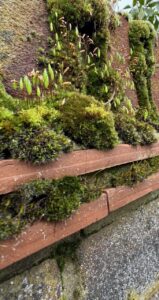

Images L-R: 1. completely covering brick wall; 2. between clay tile creasings; 3.inbetween stones of a dry stone wall.
These uses show moss’s ability to weave between hard and soft landscape elements — balancing structure with softness, and conveying a quiet maturity that few plants can match.
One of the most attractive aspects of moss is how little it asks once established:
Low maintenance: Moss never needs mowing, fertilising or edging. In suitable conditions (cool shaded ground with adequate moisture), it sustains itself with minimal intervention.
Soil and moisture benefits: Moss acts as a living mulch, helping retain soil moisture and reducing erosion around vulnerable plants.
Year-round greenness: In the UK’s temperate climate, many moss species remain lush even in autumn and winter.
Moss isn’t suitable everywhere — it prefers shade, moisture and low competition — but where conditions are right it delivers rich rewards with minimal care.
Like most plants, using the right species in the right situation is key to its success. The most common species seen around urban areas in the UK are
Silver-moss (Bryum argenteum),
Rough-stalked Feathermoss (Brachythecium rutabulum),
Springy Turf-moss (Rhytidiadelphus squarrosus),
Wall Screwmoss (Tortula muralis),
Grey-cushioned Grimmia (Grimmia pulvinata),
Silky Wall Feathermoss (Homalothecium sericeum),
Thickpoint Grimmia (Schistidium crassipilum)
For advice on which moss is right for your particular soil type and environment, or any questions on using moss in your garden design, contact [email protected] for a consultation.
For designers and clients in the UK, moss is readily available commercially. Specialist nurseries supply fresh garden moss and sphagnum, and have featured in major UK landscape exhibitions and installations, including RHS Chelsea projects and BBC Gardeners’ World.
Options include:
Live moss sheets or fragments (e.g. carpet and sheet moss) to establish groundcovers.
Preserved moss panels for interior or vertical features.
Moss kits and mixes designed for easy installation in containers and planters.
Ethical sourcing is important — many suppliers now offer responsibly cultivated moss for horticultural use, avoiding the ecological damage of indiscriminate wild harvesting.
Moss may be quiet and understated, but it’s a powerful design element. Its rich texture, low maintenance demands and capability to evoke age and serenity make it a highly versatile plant palette for gardens of all scales. Whether you’re creating a woodland retreat, an intimate courtyard or reimagining problem areas of shade and moisture, moss deserves a place in the designer’s toolbox.
In the quest for sustainable living, urban landscapes are evolving, with nature being brought back into cities in innovative ways. Popular among landscape architects and designers is the installation of living green walls, also known as vertical gardens. These are not just a stylish way to adorn a building’s exterior; they offer numerous environmental, social, and aesthetic benefits. However, like any other concept, they come with their set of challenges. Let’s dive into modular living green walls, exploring their advantages, disadvantages, and how modular systems work.
A living green wall is any vertical structure covered or partially covered with vegetation. In nature, plants can be seen inhabiting holes and cracks in cliff faces and rocky outcrops. Depending on climate and environment certain species will thrive, although only lichens can withstand sea spray. Even old man-made walls such as brick and flint can attract small plants (via seed settling in holes) if pointing is missing and there is a reasonable supply of rainfall or water from downpipes, etc.
In urban spaces, a more ornamental, if somewhat artificial version can be created by planting directly into specialised modular panels or pockets that can be installed on wall facades. These allow for a much denser planting than will be found in nature and can therefore be useful in completely covering an unattractive vertical surface such as concrete or cheap brickwork. However they depend on the use of irrigation or hydroponic systems for survival. Whether inside or outside, they are a sustainable way to incorporate nature into urban environments.
Improved Air Quality Green walls act as natural air filters. The plants absorb carbon dioxide, pollutants, and toxins, and release oxygen, improving the air quality around them. In areas with high pollution levels, living walls can significantly reduce particulate matter in the air, making urban spaces healthier for their inhabitants.
Thermal Regulation One of the most important advantages of living green walls is their ability to regulate temperature. Plants on the side of buildings provide shade, and in summer help cool the building by reducing the heat absorbed by the exterior surfaces. This in turn reduces the need for air conditioning and lowers energy consumption. During winter, green walls provide an additional layer of insulation, helping to conserve heat inside.
Aesthetic Appeal and Well-Being Green walls enhance the visual appeal of any space. Whether they are used to cover drab, concrete exteriors or transform a dull indoor environment, living walls bring a natural, vibrant touch to any setting. Studies have shown that exposure to plants can reduce stress and improve mental health, promoting a sense of well-being. The greenery provides a calming influence in busy, often stressful urban settings.
Noise Reduction Urban areas are often noisy, but green walls can act as natural sound barriers. The plants and their structures help absorb and deflect sound, leading to quieter indoor and outdoor spaces. This is especially beneficial for buildings located near busy streets or industrial zones.
Biodiversity Enhancement Living green walls help bring wildlife into the heart of cities. Birds, insects, and other creatures are drawn to the plants for food, shelter, and nesting sites. This promotes urban biodiversity, contributing to the overall ecological health of a city.
High Installation and Maintenance Costs One of the main drawbacks of green walls is the initial cost. Installing a living wall requires professional planning and installation, as well as a well-designed irrigation system. Additionally, maintaining a green wall involves regular checks to ensure the plants are healthy, and the system is functioning properly. Watering, pruning, and pest control are just a few of the ongoing maintenance tasks that can add to the overall cost.
Watering and Irrigation Challenges While green walls are designed with irrigation systems in mind, they still require a significant amount of water. In areas where water conservation is important, the irrigation needs of a green wall may become a concern.
Weight and Structural Concerns The weight of the plants, soil, and irrigation system can place a strain on a building’s structure. It's essential to ensure that the building can support the additional weight of the living wall, particularly in older buildings or those with limited structural integrity.
Limited Plant Selection for Certain Climates The choice of plants is crucial for the success of a living green wall. Not all plants are suitable for vertical gardens, and orientation and climate plays an important role in determining what will thrive. Extreme temperatures or harsh sunlight conditions can make it difficult to grow certain types of plants.
Choosing the right plants for a living green wall is key to its success. Some plants thrive in vertical gardens, while others may struggle. Looking at the natural habitat of a plant species will help to determine its suitability. Here are some of the best plant choices for living green walls:
Succulents
Succulents are an excellent choice for living walls because they are drought-tolerant and low-maintenance. Their ability to store water in their leaves makes them ideal for areas where water conservation is important. Examples include sedum, echeveria, and agave.
Ferns
Some small ferns are well-suited for shady, humid environments, making them perfect for a north facing wall. They are hardy and easy to grow - examples include wall-rue ferns and Maidenhair spleenwort.
Ivy
English Ivy Hedera helix is often used in green walls because of its fast-growing nature and ability to cover large areas quickly.
Herbs
Herbs like basil, rock samphire, and thyme are for those who want an edible garden. They can thrive in sunny spots and provide the added benefit of fresh herbs for cooking.
Flowers
Flowering plants like Centranthus, Armeria, Petunia, and Lobelia can add a splash of color to a living green wall. However, these may require more attention, particularly with regard to sunlight and watering.
Grasses
Ornamental grasses like fescue can add texture and movement and are especially well-suited for walls with sun exposure.

Sturdy metal frames are fixed to the building or other structure, creating an air gap between plants and the wall. A series of plant pockets or cassettes, that hold individual plants are fixed to the frame and supplied with water either by a drip irrigation system, or by a series of gutters that allow plants to draw up the water through capillary action. Behind the system, water will be supplied by a hidden reservoir or even attached to the mains water supply.
Living green walls are more than just a decorative trend; they offer numerous environmental, social, and economic benefits. From improving air quality and reducing energy costs to enhancing mental well-being and promoting biodiversity, they are a testament to how nature can be integrated into urban life. However, they require careful planning and maintenance to ensure their long-term success. By choosing the right plants and locations and understanding the challenges involved, green walls can transform urban spaces into vibrant, sustainable, and beautiful environments for all to enjoy.
1. YOU KNOW THE ORIGIN AND PROVENANCE OF WHAT YOU ARE EATING
In the UK we have regulation surrounding the use of pesticides on our agricultural crops that have potential to cause harm to humans or the environment. But are we as environmentally friendly as we ought to be and what about other countries that export to the UK?
As of 2019, as many as 72 pesticides were approved for outdoor agricultural application in the USA that were banned in the EU. Peru still uses harmful pesticides today to boost production and meet consumer demand. These pesticides create residues which end up in our food. Developing countries cite a lack of available alternative chemicals or ‘economic reasons’, in spite of a broad understanding of the dangers to human health and ecology.
A study in 2013 tested well-known tea brands for 365 different illegal pesticides. It revealed that tea companies in both India and China are exposing people to illegal pesticides by including residues in their tea. Twenty six teas tested that claimed to be ‘all natural’ contained pesticides that were not approved for use and some contained carcinogens.
Alarmingly, just last year the UK lifted the ban on a pesticide known to harm both wild bees and honey bees because of an urgent threat to the sugar beet crop from a virus spread by aphids. Moreover, Greenpeace reported in 2020 that the UK was Europe’s biggest exporter of toxic banned pesticides to poorer countries such as South Africa, Ukraine and Brazil. Ukraine by the way, is the world’s top producer of sunflower oil and seed and a major exporter of wheat and barley.
2. GROWING ORGANIC IS SAVING POLLINATORS
Most people growing their own veg at home do not find the need to spray their crop with chemicals to control pests or diseases, as they are growing in small numbers. By avoiding pesticides, herbicides and fungicides, they are by default growing organically. As most vegetables and fruit are insect-pollinated, home growers are helping the local wildlife while also reducing demand for inorganic vegetables whose intense farming methods may be harming pollinators (and humans).
3. YOU ARE SAVING AIR MILES AND THE PLANET
Unless you conscientiously buy British all the time then you are probably buying green beans from Kenya (6,000 miles), avocados from Peru (6,000 miles) and tomatoes from Spain (1,500 miles). According to Friends of the Earth, flying green beans from Kenya produces 3.8 kilograms of carbon dioxide per kilogram of food. To put this in perspective, one fully-grown tree absorbs just 25kg of CO2 in a whole year.
4. THE FINANCIAL GAIN CAN BE SUBSTANTIAL
Let’s compare the cost of tomatoes to buy from a supermarket vs. tomatoes grown at home.
A popular salad tomato plant such as ‘Moneymaker’ can yield 30 tomatoes if pruned correctly - this one plant from a single seed can therefore produce tomatoes worth around £8.00. But grown organically, this plant becomes more valuable: 30 organic tomatoes would cost around £14. Plant ten tomato seeds at regular intervals and you have £140 of tomatoes available in succession to be used fresh, or made into chutney or tomato sauce! The cost of growing is minimal: you only need a bag of compost (£4/5) and tomato feed (£2.62 for 1L)*
5. YOU CAN GROW FRUIT AND VEG NOT AVAILABLE TO BUY
We are advised by nutritionists that when it comes to gut health, diversity is key. In fact we should be eating 30 different types of plant weekly to increase the good bacteria in our gut. Why not try growing unusual edibles such as Vietnamese coriander, romanesco or Brusselberry sprouts? You can even try growing your own tea leaves (from Camellia sinensis). Our hunter-gatherer ancestors ate up to 500 different local roots, herbs and plants in a year. Compare that to our diet today in which on average we eat only 15-17 different types.

Brusselberry sprouts, sweeter and milder than ordinary sprouts, with purple leaves
6. YOU DON'T HAVE TO GO OUT TO BUY YOUR NEXT MEAL
Imagine being able to pick your veg just outside your back door and not having to get in the car…. Back garden to plate - under 30 metres.
7. GARDENING IS PROVEN TO BE BENEFICIAL TO PHYSICAL AND MENTAL HEALTH
The RHS tells us that 30 minutes of gardening is comparable to playing badminton or practising yoga. Apart from the exercise element, a King’s Fund report found gardening also significantly reduced depression and anxiety, improved social functioning and helped prevent cognitive decline. Gardening is now prescribed by GPs for both rehabilitation and as a preventative mechanism.
8. HOME GROWN MAKE GOOD PRESENTS
Giving a gift that you have created / made / grown yourself just has so much more meaning. And you will feel proud of yourself for having achieved it. Especially if it’s the biggest carrot you’ve ever seen, or a vegetable that isn’t available to buy.
9. ALLOW YOUR PLANTS TO FLOWER AND YOU WILL HAVE FREE SEED FOR NEXT YEAR
Seeds come from flowers at the end of the plant’s lifecycle. So once you have harvested all you want, make sure you leave some flowers on the plant to dry out and produce seed. Collect before they drop to the ground.
10. SUPERIOR TASTE AND FRESHNESS
It makes sense that a cauliflower or raspberry that has been left to mature/ripen on the plant and then eaten within minutes of harvesting tastes better than one that was picked while unripe - then possibly treated to slow down ripening and prevent degradation before consumption.
Vegetables grown around the world for export are processed quickly to retain freshness and many undergo some kind of preservation treatment. Some shredded cabbage products for example, are washed in a chlorine rinse to inactivate microorganisms. Vegetables are vacuum packed in a (harmless) gas mixture. Unfortunately refrigeration straight after harvest cannot eliminate all pathogen and spoilage microorganisms; for example Listeria monocytogenes and E. coli are able to multiply slowly in refrigerated foods. That is not to say that E.coli is not present on home grown fruit and veg, but by taking the right steps the home grower can reduce the risk of unwanted pathogens ending up on the plate. By picking fresh from the garden when required for consumption, and washing well in clean water, you will enjoy a superior quality and taste. Try a sweet, fresh broad bean picked green and young from the plant and you will be amazed at the difference to its frozen supermarket relative.
by Paula Napper
Chalcot Garden Design
*Prices correct as of April 2023.
References:
https://www.theguardian.com/environment/2022/mar/01/bee-harming-pesticide-thiamethoxam-uk-emergency-exemption
https://www.eea.europa.eu/articles/forests-health-and-climate-change/key-facts/trees-help-tackle-climate-change#:~:text=Over%20one%20year%20a%20mature,of%20pollutants%20from%20the%20air.
https://www.heraldscotland.com/default_content/12486492.green-beans-trip-kenya-plate/
https://assets.publishing.service.gov.uk/media/57a08ba940f0b652dd000df8/60506-fp12.pdf
https://www.downtoearth.org.in/news/pesticides-banned-20474
https://www.intechopen.com/chapters/81416
https://ehjournal.biomedcentral.com/articles/10.1186/s12940-019-0488-0#:~:text=Paraquat%20and%20phorate%20are%20the,over%20their%20safety%20%5B73%5D.
https://www.rhs.org.uk/advice/health-and-wellbeing/articles/why-gardening-makes-us-feel-better
© Copyright Chalcot Garden Design 2023. All Rights Reserved. Privacy.
Chalcot Garden Design is a trading name of Napper Limited, a company registered in the UK under company number 09119703