A wet January and February
A notably wet start to the year with above-average rainfall, has created ideal conditions for a massive, rapid increase in moss growth on brick walls, coping stones, driveways, concrete paths and lawns. Permanently saturated ground, damp walls and low light levels have allowed moss to successfully spread.
How moss is different to other plants
Moss belongs to a division of plants called bryophyta. Rather than relying on deep roots, moss draws moisture and nutrients directly from the air and rain — a trait that gives it extraordinary adaptability to grow on hard materials like stone and concrete, and shaded, low-fertility or damp environments where grass and many ornamentals struggle. Moss doesn’t just survive in these conditions — it thrives, knitting surfaces together with soft, natural texture. This quality gives designers a tool for defining spaces in ways other groundcovers cannot.
How to use moss in your garden design
One of moss’s most compelling visual qualities is texture. Planted en masse or layered around features, moss creates a velvety surface that contrasts beautifully with architectural elements and coarser planting. Understanding its natural growth habit and emulating this in your own garden will give an authentic outcome.
-
Under Trees and in Shady Corners: A moss carpet beneath the tree canopy gives a restful, shaded groundcover that stays green year-round — ideal where turf fails. For a layered planting, install shrubs, ferns, hostas and moss to create a woodland understory. A woodland walk at this time of year will give inspiration for how to plant: moss grows at the base of trees, on fallen, rotting logs and in hollows in the ground where moisture is trapped.
-
Between paving slabs: Moss growing in the joints of stone paving transforms a pathway into an intentional design element — softening its edges and bringing rhythm to straight paths or highlighting pattern in crazy paving.
-
Walls and rocks: Use moss in wall crevices and draped over stone boulders in shade to add a sense of age and a feeling of continuity with nature.
-
Around water Features: Planting around any type of water feature is an obvious place for moss plantings to look at home; combine with other water loving plants like Siberian iris and Darmera for an authentic damp environment.
- Log piles: A log pile is a hiding place for hedgehogs, invertebrates, frogs and toads. Foragers will visit to feed. Decomposing log piles are moist and an ideal habitat for mosses. Add a log pile with mosses in to your wildlife-friendly garden design.
- Lawn alternative: For north-facing lawns where turf struggles, moss can be a pragmatic and aesthetic alternative. A moss lawn stays green with minimal irrigation and no mowing, framing shrubs, water features or seating with a calming, soft expanse. It’s a particularly successful approach in woodland and shade gardens where traditional grass fails.

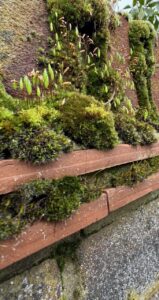

Images L-R: 1. completely covering brick wall; 2. between clay tile creasings; 3.inbetween stones of a dry stone wall.
These uses show moss’s ability to weave between hard and soft landscape elements — balancing structure with softness, and conveying a quiet maturity that few plants can match.
Practical Benefits: Low Maintenance and Ecological Value
One of the most attractive aspects of moss is how little it asks once established:
-
Low maintenance: Moss never needs mowing, fertilising or edging. In suitable conditions (cool shaded ground with adequate moisture), it sustains itself with minimal intervention.
-
Soil and moisture benefits: Moss acts as a living mulch, helping retain soil moisture and reducing erosion around vulnerable plants.
-
Year-round greenness: In the UK’s temperate climate, many moss species remain lush even in autumn and winter.
Moss isn’t suitable everywhere — it prefers shade, moisture and low competition — but where conditions are right it delivers rich rewards with minimal care.
Which moss species should I use?
Like most plants, using the right species in the right situation is key to its success. The most common species seen around urban areas in the UK are
Silver-moss (Bryum argenteum),
Rough-stalked Feathermoss (Brachythecium rutabulum),
Springy Turf-moss (Rhytidiadelphus squarrosus),
Wall Screwmoss (Tortula muralis),
Grey-cushioned Grimmia (Grimmia pulvinata),
Silky Wall Feathermoss (Homalothecium sericeum),
Thickpoint Grimmia (Schistidium crassipilum)
For advice on which moss is right for your particular soil type and environment, or any questions on using moss in your garden design, contact [email protected] for a consultation.
Sourcing Moss in the UK
For designers and clients in the UK, moss is readily available commercially. Specialist nurseries supply fresh garden moss and sphagnum, and have featured in major UK landscape exhibitions and installations, including RHS Chelsea projects and BBC Gardeners’ World.
Options include:
-
Live moss sheets or fragments (e.g. carpet and sheet moss) to establish groundcovers.
-
Preserved moss panels for interior or vertical features.
-
Moss kits and mixes designed for easy installation in containers and planters.
Ethical sourcing is important — many suppliers now offer responsibly cultivated moss for horticultural use, avoiding the ecological damage of indiscriminate wild harvesting.
Conclusion: Making Moss Work in Design
Moss may be quiet and understated, but it’s a powerful design element. Its rich texture, low maintenance demands and capability to evoke age and serenity make it a highly versatile plant palette for gardens of all scales. Whether you’re creating a woodland retreat, an intimate courtyard or reimagining problem areas of shade and moisture, moss deserves a place in the designer’s toolbox.